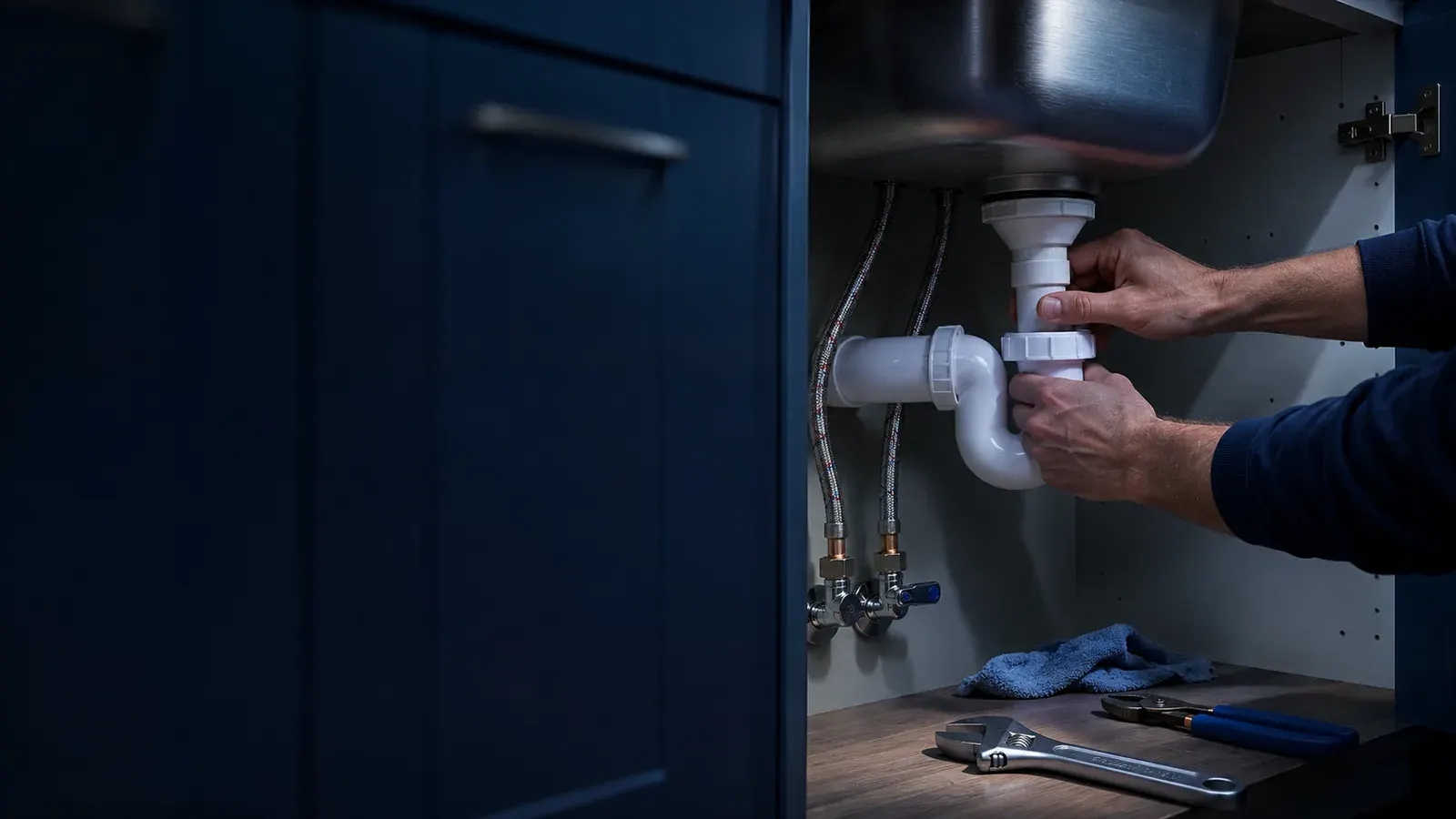
Bottle trap installation for a basin: sizes and seal depth, setting inlet and outlet height, cutting the wall pipe, hand tightening washers and leak testing.
A bottle trap screws onto the basin waste, holds a pocket of water to keep drain air out, and passes the flow to a horizontal pipe. To fit one, set its height so the waste pipe leaves the wall with a gentle fall, join it with the washers in the correct order and test with a full basin.
Check size and seal
Approved Document H lists a washbasin trap of 32 mm with a 75 mm water seal. A 50 mm seal is allowed only with flush grated wastes without plugs on spray tap basins. Read the seal depth on the product, since some very shallow decorative traps are meant for other situations.
The same document expects a trap to be removable or to have a cleaning eye. On a bottle trap the lower cup normally unscrews, so leave room for your hand and a bowl beneath it.
Measure before buying
| Measurement | Why it matters |
|---|---|
| Waste thread to floor | Confirms the trap will fit below |
| Waste centre to wall | Sets the outlet pipe length |
| Existing wall pipe height | Shows whether the outlet can meet it |
| Pipe size at the wall | Decides whether an adaptor is needed |
| Drawer or pedestal clearance | Avoids a clash after fitting |
Most bottle traps have a telescopic inlet that adjusts height. It cannot lift an outlet above the basin waste or turn a rising pipe into a falling one. If the wall connection is too high, the pipe behind needs altering.
Prepare
Gather the new trap, cloths, a bowl, a fine saw or pipe cutter and a file. Empty the old trap into the bowl and remove it. Cover the open wall pipe while you work so that smells stay out and nothing drops in. Check the waste thread is clean and that the basin waste itself does not move.
Dry fit
- Slide the cover plate onto the outlet tube if the design has one.
- Offer the trap to the waste with the outlet pushed into the wall connection.
- Set the height so the body hangs plumb and the outlet falls slightly towards the wall.
- Mark where the inlet and outlet tubes need trimming.
- Cut square, then remove every burr so washers are not sliced.
Cut a little long first. A tube that barely reaches into its seal may pull out when someone cleans round it.
Assemble
Fit each nut, then each washer or cone in the direction shown on the sheet. Start the threads by hand. Tighten the waste connection, then the wall joint, then check the cup. Hand tight is the normal instruction for plastic seals; metal decorative traps may call for a wrapped spanner. Over-tightening distorts washers and is a frequent cause of the very drip you are trying to cure.
Do not add tape or paste to a joint designed around a washer unless the maker asks for it.
Test
Fill the basin to the overflow and release it. Watch the top joint, the cup, and the outlet where it meets the wall. Dab each with dry tissue. Run the tap for a minute and listen. Gurgling, or water that drains and then pulls the seal low, suggests a problem further along the waste run, such as a long or steep pipe. Document H gives an unventilated 32 mm basin branch a maximum of 1.7 m, with the allowed length reducing as the fall gets steeper. McAlpine describes anti-syphon traps that admit air through a small valve for runs where seals get pulled.
Cleaning later
Put a bowl underneath, unscrew the cup, clear hair and paste, rinse, and refit the seal in its groove. Run water and check again. Avoid strong drain chemicals in a chromed trap unless the maker permits them.
When it is more than a trap
Ask for help if the wall pipe is cracked or loose, solvent welded with no usable length, a different old size, or positioned where no trap can connect properly. Describe the problem and what you have already bought in the contact form, then email a side-on photo with a tape measure.
Questions people ask
What size bottle trap does a basin need?
A basin trap is normally 32 mm, often sold as one and a quarter inch. Check the thread on your waste.
Can I use a bottle trap on a kitchen sink?
Sink guidance calls for a 40 mm trap, and a narrow bottle body can collect grease, so use a trap the maker intends for sinks.