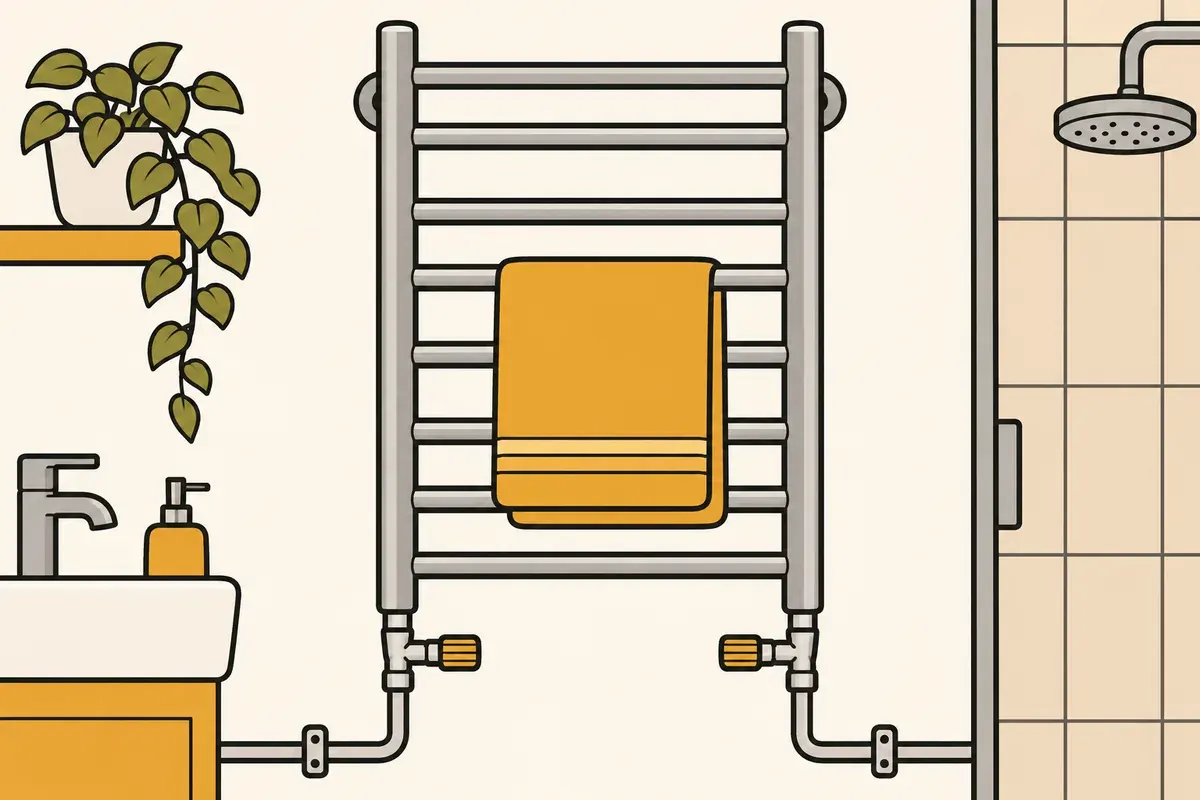
Towel radiator sizes and pipe centres: measure existing pipes, allow for valves, check height, projection, brackets and heat output before ordering.
Choose a towel rail by its pipe centres, heat output and the wall space it needs, in that order. Measure from pipe middle to pipe middle where they leave the floor or wall, then compare with the figure on the drawing including the valve allowance.
Measure pipe centres
Find the centre of each pipe where it leaves the wall or floor, then measure between the two centres. For vertical connections on a wall, measure vertically between the centres. Check that both pipes are parallel and the same distance from the wall. Valves add to the rail width by an amount that depends on the valve, so use the drawing for the pair you intend to fit.
| Record | Why |
|---|---|
| Centre to centre | Chooses compatible widths |
| Distance from wall | Valve and bracket reach |
| Height of tails | Connection to the rail |
| Pipe size | Valve compression size |
| Floor or wall exit | Straight or angled valves |
Height and width
Tall rails give more hanging space and output but need wall height clear of switches, windows and door swing. Wide rails take more wall. A rail beside a bath should be reachable without being touched by splashes or by someone sitting in the bath. Electrical models have zone restrictions.
Heat output
Rails are rated at a stated temperature difference. Compare like with like: Stelrad uses ΔT50 as the UK standard and shows correction factors for lower water temperatures. Towels covering the bars reduce heat given to the room. If the rail is the only heat source, size to the room using heat loss guidance and consider a separate radiator.
Brackets and wall
Brackets have their own fixing points, commonly different from the outer size. Check wall type; solid, stud or tiled over board. Add noggins at first fix. Water-filled rails with wet towels are heavy.
Depth
Projection from wall matters in narrow rooms. Measure to the front of the rail, valves included, and check the door and your hips.
Replacing a rail
- Note old centres, height and valves.
- Compare candidates.
- Decide on extensions or pipe moves, using extensions guidance for small differences.
- Choose valves that match the finish.
- Confirm system type before draining.
Valves and tolerances
Straight valves leave the least room for misalignment, angled valves suit floor pipes meeting side connections, and corner valves suit pipes leaving the wall below the rail. Take up a small mismatch only with a part whose maker states that it covers that distance; larger differences usually mean moving pipework. Leave permanent alterations until the rail and valves are in your hands.
Finish
Output can differ between finishes of the same size, so read the table row for your exact product and colour. Check that the finish and valves match.
Common mistakes
- Ordering from the width on the product title.
- Forgetting valve allowance.
- Ignoring pipe depth from the wall.
- Assuming a larger rail connects to the same holes.
Help
Send measurements and product links through the contact form and email photographs with your reference. Say if the rail is heating, electric or dual fuel.
Measure twice with a template
Cut paper to the rail's overall size, mark the bracket and valve points, and tape it to the wall. Open the door, stand at the basin and reach from the bath. Check that sockets, switches and the window handle remain usable, and that a folded towel will not hang against a heater control or into a splash zone. Photograph the template with a tape for reference.
Delivery checks
Unpack carefully and compare the pipe centres, bracket kit, vent and blanking plug against the sheet before the old rail comes off. Check the finish for marks, because returns are harder once a rail has been filled with water. Keep the instructions with the model code, which will be needed if a bracket or vent has to be replaced later.
Questions people ask
Are pipe centres the same as rail width?
Not always. Valves and connection positions change the figure, so read the drawing.
Can I use the old pipes?
Only if the new rail's stated centres suit them, or an extension within limits will.