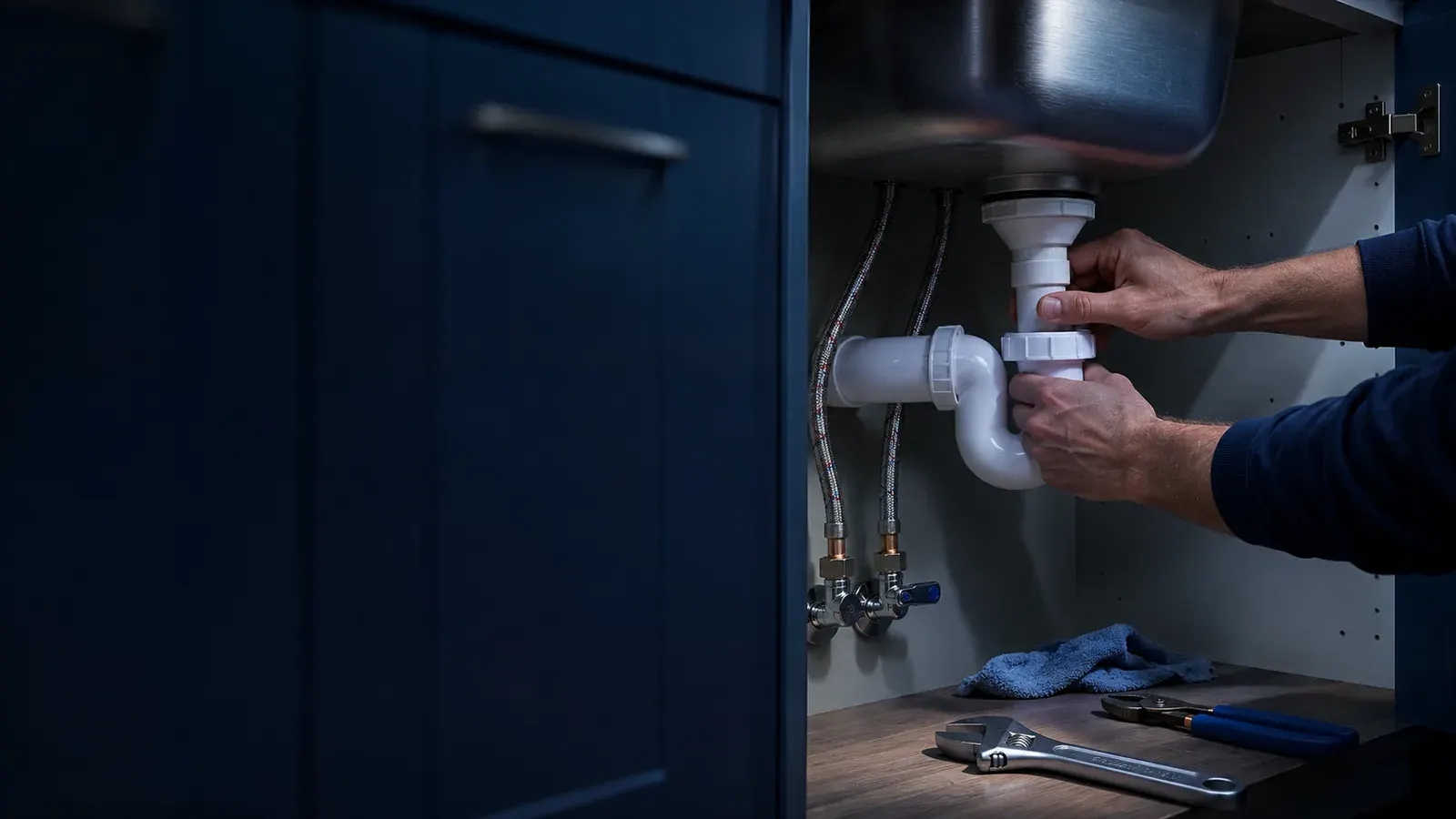
Quarter turn tap valve replacement: isolate water, remove the handle, match the ceramic valve by thread, spline and direction, refit gently and test for drips.
A quarter turn valve is the ceramic disc insert that opens a tap in about a quarter revolution. When it drips, stiffens or leaks around the stem, isolate the water, unscrew it from the tap body and fit an exact match for that side.
Confirm the type
If the handle travels only a short arc between off and full, you probably have ceramic discs. A handle needing several turns indicates a washer and spindle. A drip at the spout points to the sealing part, while a leak at the handle usually means an O-ring.
Single lever mixers use a larger combined cartridge, which is not covered here.
Isolate and protect
Shut the valve feeding that side, or the stop valve. Open the tap until the flow stops. Plug the basin and lay a cloth over it. Take a photograph of the handle in the closed position.
Take it apart
- Ease off the hot or cold cap.
- Remove the handle screw.
- Pull the handle straight upwards.
- Unscrew any shroud by hand with a cloth.
- Hold the spout so the body cannot rotate.
- Turn the valve's hexagon anticlockwise with a well fitting spanner.
If the tap begins to turn on the basin, support it better. If the hexagon will not move, penetrating force is likely to damage the plating or pipe connections.
Match the replacement
| Measure or note | Why |
|---|---|
| Body thread | Must screw into the tap |
| Overall height | Affects handle and shroud fit |
| Spline count and diameter | Handle must seat |
| Opening direction | Hot and cold may differ |
| Maker and model | Gives the safest match |
| Base seal shape | Seals against the seat inside |
Take the old part to the supplier or send the maker a photo next to a ruler. A pair sold as universal may fit neither your height nor your handle.
Refit
Check the cavity for grit or old rubber and wipe it with a clean cloth. Make sure the new base seal is present. Set the valve closed before screwing it in by hand, then tighten modestly; too much force can crack ceramic parts or crush the seal. Refit the shroud, then position the handle so it points as in your photograph.
Turn water on
Leave the tap slightly open, restore the supply slowly to expel air, then close. Watch the spout for several minutes and check the stem. Run it through its range and feel for smooth movement.
If the handle now opens the wrong way or stops short, the valve is the wrong hand or the stop ring is in the wrong position. Follow the part's sheet to correct it.
Care
Grit is the enemy of discs, so flush new pipework after plumbing work and do not wrench a handle past its stop. Hard water scale around the stem can be wiped before it stiffens the movement.
Replacing one or both
With a matching pair it can make sense to change both inserts while the tools are out, particularly if they were fitted together and one has already failed. Work on one side at a time so parts cannot be swapped. Label the spare packet with the tap name and which side it fits, and keep it with the household paperwork. If drips return within days, inspect the seat inside the body for damage and check the pipework for debris.
When to hand over
A corroded body, no obtainable valve or a supply that cannot be isolated calls for help or a new tap. Describe the fault on the contact form, then email photographs of the tap, removed part and valves under the basin.
Questions people ask
Are hot and cold quarter turn valves the same?
Often not. They commonly open in opposite directions, so replace like for like on each side.
Can a ceramic valve be repaired?
Sometimes cleaning or a new seal helps. Cracked or scored discs mean replacing the valve.